
Inclusive Leadership Coaching
Belonging Is a Leadership Discipline. Not a Program.
Building the conditions where high performance and inclusion reinforce each other — through how leaders actually show up.
Leadership Challenge Overview
Inclusive leadership coaching addresses the gap that compliance-based programs consistently leave: the daily leadership behaviors that determine whether belonging is actually present in an organization, or only declared. Michael Rolph's approach centers on Earned Candor — the conditions leaders build, through consistent behavior over time, where honest thinking surfaces and diverse teams perform at their full capability. Deloitte's research on inclusive teams shows 17% higher performance, 20% better decision-making quality, and 29% stronger collaboration. Michael holds a Diversity Trainer Certification from the National Conference on Race and Ethnicity and has coached senior leaders across technology, government, and nonprofit organizations globally. Engagements are 1:1, confidential, and available globally via video.
THE LEADERSHIP MOMENT
The Language Has Changed. The Challenge Hasn't
In 2025 and 2026, the language around diversity, equity, and inclusion shifted dramatically. Major corporations quietly removed DEI from their filings. Some scaled back programs. Others renamed them. The Academy of Management's 2026 research put it plainly: after experiencing backlash and fatigue, leaders are reframing inclusion as a measurable capability that improves decision quality, risk management, and innovation — with "inclusive" giving way to words like "collaborative," "relational," and "human-centered."
One in three companies that rolled back DEI initiatives are reinstating them. One in seven business leaders now views scaling back as a mistake.
What the language shift reveals is that the compliance-based model for building inclusion was already under strain. Training programs, annual surveys, and policy documents were producing documentation, not culture. The leaders who understand this have been asking a more useful question: not how do we comply with inclusion requirements, but how do we build the organizational conditions where belonging is genuinely present — and high performance follows.
That question is where this work lives. Explore the business case for that question: Why Belonging Is a Leadership Discipline — Not a Compliance Checkbox
THE APPROACH
Earned Candor — Built Through Behavior, Not Mandate
The condition that defines a genuinely inclusive organization isn't a policy or a program. It's candor — the state where honest thinking surfaces because of how the leader consistently responds when it does.
When a team member with a different perspective speaks up and is met with genuine curiosity rather than defensiveness, they learn something about this leader and this environment. When that happens consistently enough, it shapes what people are willing to bring to the work. Difference gets expressed rather than managed. Problems surface before they compound. Performance follows.
You cannot mandate a culture. You can only build the conditions for one — and those conditions are created by how leaders consistently behave, not what they declare.
I call this Earned Candor. It's earned through repeated leadership behavior — not installed through training, not mandated through policy. And it's the condition that underlies everything else: diverse teams perform when their perspectives are genuinely welcomed, not when inclusion is performed.
I write regularly on Earned Candor and inclusive leadership on LinkedIn. Learn more, and follow on LinkedIn → Michael Rolph LinkedIn
THE AI DIMENSION
AI Is Creating New Belonging Challenges
AI adoption has added a dimension to inclusive leadership that didn't exist in the same way before. When AI reshapes roles, changes how work gets done, and generates genuine uncertainty about human value in organizations, belonging becomes more fragile — and a more urgent leadership priority.
O.C. Tanner's research finds that 63% of employees fear AI will make their work experience less personal. That concern lands on the leader's desk. The leaders navigating this well aren't managing the concern — they're building the leadership climate where people can bring honest anxiety to the conversation and receive genuine engagement in return.
The intersection of AI transformation and inclusive leadership is where some of the most urgent coaching work now lives. The conditions that enable candor and belonging in an AI-era organization are the same ones that make AI adoption sustainable — because they're about whether people trust the environment enough to engage honestly, flag problems, and contribute their full capability. Explore this phenomena more: Your Emotions Are Doing Calculations AI Can't — And That Makes Them a Leadership Superpower→
THE PERFORMANCE CASE
This Is a Business Performance Question
The business case for inclusive leadership is now well-established — from the firms whose research shapes board-level thinking.
Deloitte's research on inclusive teams shows organizations with strong inclusion practices achieve 17% higher performance, 20% better decision-making quality, and 29% stronger collaboration. Gallup's 2026 State of the Global Workplace found only 20% of employees worldwide were engaged — representing an estimated $10 trillion in lost global productivity — with manager quality identified as the root cause.
Deloitte's research on inclusive teams shows 17% higher performance, 20% better decision-making quality, and 29% stronger collaboration. These are not culture metrics. They are performance metrics.
The financial stakes of getting this wrong are concrete. Target's decision to roll back its DEI initiatives in early 2025 resulted in a documented $12.4 billion loss in market value and 4.9 million fewer store visits. Costco, which maintained its commitment to inclusion, gained 7.7 million visits in the same period.
The leaders building genuine belonging — through Earned Candor and the specific behaviors that create Leadership Climate — are protecting organizational performance. Not just values.
WHO THIS WORK SERVES
Three Audiences Find This Work Directly Relevant
Senior leaders navigating the DEI reframing — executives who need to maintain genuine commitment to inclusion while navigating the political complexity of current language. The work builds the behavioral substance the reframing requires: actual leadership conditions, not new vocabulary over old patterns.
Leaders building high-performance cultures where belonging and performance reinforce each other — executives who recognize that the candor, trust, and honest engagement of their teams are performance assets, and want to develop the specific behaviors that create those conditions.
First-generation executives, women in leadership, and leaders of color navigating organizations where they've had to work harder to be seen — this is a meaningful part of this practice, and the coaching reflects genuine cross-cultural and lived experience across three decades of leadership work.
If you're navigating any of these questions and want to explore what the work looks like in your specific context, Book a Conversation →
THE ENGAGEMENT
Individual Coaching for the Leader Who Wants to Build This
Individual coaching develops the specific behaviors that create Earned Candor: how you respond when someone challenges your thinking, what you do when a team member surfaces a problem, how you make it visible — through repeated action — that honest contribution is valued here.
The engagement is 1:1, confidential, and built around the specific situations and leadership dynamics you're navigating. There is no standard curriculum. The work starts where you are.
For leadership teams building shared norms and inclusive climate across a cohort, organizational coaching is available through the Organizational AI Coaching practice.
This work sits alongside Leadership Coaching and AI Executive Coaching as part of a practice focused on the leadership conditions that drive organizational performance.
Inclusive Leadership in Conversation
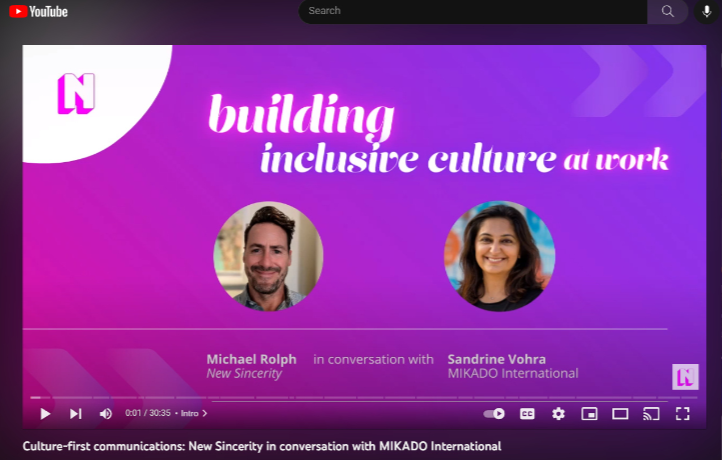
Inclusive Leadership in Conversation
A Conversation on Culture and Performance
Michael Rolph in conversation with Sandrine Vohra, CEO of MIKADO — a multicultural marketing agency operating at the intersection of global brand and cultural intelligence. They discuss what it actually takes to build inclusive, high-performing cultures: the hard decisions, the blind spots, and the moments when values get tested.
CREDENTIALS
The Depth Behind the Work
Michael Rolph holds a Diversity Trainer Certification from the National Conference on Race and Ethnicity and a Social Sector Leadership certificate from UC Berkeley Haas. His graduate training was in counseling psychology and cross-cultural communication. He has coached senior leaders across technology, government, nonprofit, and social impact organizations — including first-generation executives, women in leadership, and leaders of color navigating complex organizational environments.
This work is informed by 25 years across Silicon Valley technology leadership, the U.S. Department of State, and international organizational leadership — with lived cross-cultural experience across multiple countries and professional contexts.
Full background: About Michael Rolph →
“Michael has helped me make the difficult choices a leader has to make.”
If you're ready to build the conditions where honest thinking surfaces and your team performs at its full capability, start a conversation.